Key Points
- VI Peel removes damaged surface skin chemically - strongest on pigmentation, tone, and clarity.
- Microneedling creates controlled micro-injuries to stimulate collagen - strongest on texture, acne scarring, and firmness.
- Downtime differs in character: the peel gives you visible flaking days 3–7; microneedling gives you redness and swelling for 1–3 days.
- Both typically need a series. Peels run 4–6 weeks apart; microneedling commonly runs similar intervals.
- They aren’t rivals. Many plans alternate both over time, properly spaced - never in the same week.
- The right choice depends on your primary concern, your skin type, and your downtime tolerance.
If you’ve been researching how to improve your skin and keep landing on both of these treatments, the confusion is reasonable. They’re offered by the same practices, priced in a similar range, promise overlapping benefits, and both involve a few days of looking not-quite-normal. So which one actually addresses your problem?
The short version: they work through completely different mechanisms and therefore excel at different things. A peel works from the outside in, chemically removing damaged surface skin. Microneedling works from the inside out, triggering your own collagen response. Once you understand that distinction, choosing gets much easier.
How Each Treatment Actually Works
The VI Peel
A VI Peel is a medical-grade chemical peel. Its solution - a blend that typically includes TCA, salicylic acid, phenol, and vitamin C - is applied to the face and left on for a set number of hours before you rinse it at home with cool water.
The solution loosens the bonds holding damaged surface skin cells together. Over the following days, that layer sheds, revealing fresher skin underneath. The process also prompts renewal in deeper layers, which is why results continue developing after the visible flaking stops.
The signature experience is the peeling itself: tight and dry for a day or two, then visible flaking from roughly day 3 through day 7, then fresh skin.
Microneedling
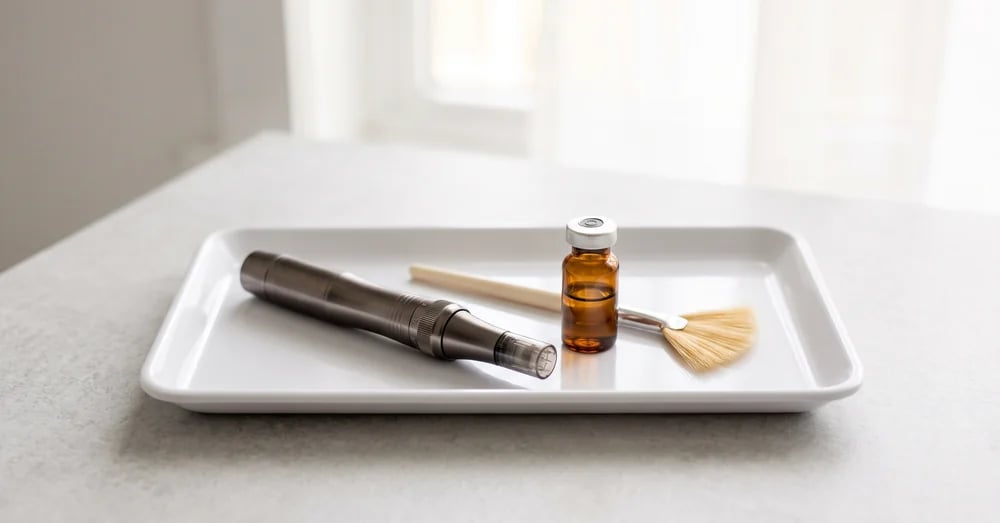
Microneedling uses a device with fine needles to create controlled micro-injuries in the skin. These channels are tiny and heal quickly, but they trigger the body’s wound-healing response - which means new collagen and elastin production.
That collagen response is the entire point. Rather than removing the surface, you’re prompting the skin to rebuild its underlying structure. Because collagen takes time to form, microneedling results emerge over weeks to months rather than in a single dramatic reveal.
The signature experience is different: redness and mild swelling resembling a sunburn for one to three days, then a return to normal, with results building quietly afterward.
Some practices also offer radiofrequency microneedling, which adds RF energy to the needling for additional tightening effect. See our radiofrequency skin resurfacing page and our RF microneedling recovery guide for more on that variant.
Side-by-Side Comparison
| VI Peel | Microneedling | |
|---|---|---|
| Mechanism | Chemical exfoliation of damaged surface skin | Controlled micro-injury stimulating collagen |
| Best for | Pigmentation, melasma, sun spots, dull tone, clarity, mild acne | Texture, acne scarring, enlarged pores, fine lines, firmness |
| Visible downtime | Flaking days 3–7 | Redness and swelling 1–3 days |
| Result timing | Brightness within ~1 week; pigment keeps improving 2–3 weeks | Builds over weeks to months as collagen forms |
| Typical series | 3–6 sessions, 4–6 weeks apart | Series commonly recommended, similarly spaced |
| Peeling? | Yes, pronounced | Minimal to none |
| Sun sensitivity after | High - strict SPF essential | Elevated - SPF essential |
Which Treats Your Concern Better?
For pigmentation, melasma, and sun damage → usually the VI Peel
Pigmentation sits largely in the surface layers, so a treatment that removes those layers directly addresses it. The VI Peel, and particularly VI Peel Precision Plus with its pigmentation booster, is built for this. Microneedling isn’t principally a pigment treatment, and in some pigment-prone patients aggressive needling can risk post-inflammatory hyperpigmentation.
If discoloration is your main complaint, start with the peel. Our guide to VI Peel for melasma and hyperpigmentation goes deeper on this.
For acne scarring and texture → usually microneedling
Indented acne scars, rolling scars, and rough texture are structural problems - the issue lives beneath the surface, in how the skin is built. Removing surface layers doesn’t rebuild structure; stimulating collagen does. Microneedling is the more targeted tool here.
That said, if your “acne scarring” is actually flat dark marks left behind by past breakouts - post-inflammatory hyperpigmentation rather than true indentation - then you’re really dealing with pigment, and a peel may serve you better. It’s a common and important distinction, and one a provider can sort out by looking at your skin. Our post on chemical peels for acne scars covers where peels do help.
For active acne → either, depending
The VI Peel contains salicylic acid and is used for acne as well as for clearing the marks acne leaves behind. Microneedling is generally avoided over active inflamed lesions. If you’re actively breaking out, discuss sequencing with your provider.
For fine lines and firmness → usually microneedling
Collagen stimulation is the mechanism that addresses laxity and fine lines at a structural level. A peel softens the appearance of fine lines by resurfacing, which helps, but microneedling works on the underlying support.
For overall dullness and a general refresh → usually the VI Peel
If your complaint is that your skin looks tired, uneven, and lacking glow, resurfacing delivers that more directly and more visibly within a week.
For enlarged pores → usually microneedling
Pore appearance relates to surrounding collagen support. Needling tends to be the better-matched approach.
Downtime: Which Is Actually Easier?
Both are usually described as “minimal downtime,” but they’re minimal in different ways, and which one fits your life depends on your circumstances.
The VI Peel’s downtime is visible but predictable. You know roughly when it happens - flaking peaks days 3 through 5 - and you can plan around it. Moisturizer disguises a lot. Most people work throughout. But you will visibly flake, and if your job puts you on camera or in front of clients, those specific days matter.
Microneedling’s downtime is shorter but more immediate. You’ll look noticeably red and slightly swollen right after, typically resolving within one to three days. There’s no flaking phase to manage, but the redness is at its most obvious on day one, when the peel would still have you looking normal.
Practical takeaway: if you need to look fine tomorrow, the peel is the safer bet. If you need to look fine on day four, microneedling is. Neither is right for the day before a wedding.
Both leave skin more sun-sensitive, which in Phoenix means disciplined daily SPF regardless of which you choose.
Can You Do Both?
Yes - and many well-built plans do, over time. The two treatments address different layers and different problems, so combining them across a year can cover more ground than either alone.
The critical rule is spacing. These don’t go in the same week. Stacking resurfacing treatments close together compounds irritation without compounding benefit, and irritated skin is more prone to pigmentation problems. Your provider will build a sequence with appropriate gaps - commonly alternating treatments across a schedule rather than running them concurrently.
A typical logic might be: address pigmentation with a peel series first, let skin settle, then move to microneedling for texture and collagen. Or alternate them on a longer maintenance cadence. The specifics depend entirely on your skin and goals, which is exactly what a consultation determines.
What you should not do is book one of each at different practices without telling either provider. Always disclose recent treatments.
Cost Considerations
Both treatments are typically priced per session with package pricing available, and both usually require a series - so the meaningful number is the total cost of a course, not the single-session price.
For a full breakdown including what’s included and how packages work, see VI Peel cost in Phoenix.
For microneedling pricing and what a course looks like, ask at consultation - it varies with the protocol and whether RF is involved.
Worth noting for regulars: our Aesthetic Membership is designed for people doing ongoing treatments, which is exactly the profile of someone planning a series of either.
Which Should You Choose? A Simple Framework
Ask yourself what bothers you most when you look in the mirror.
“My skin tone is uneven / I have dark patches / I look dull.” → Start with the VI Peel.
“My skin texture is rough / I have indented scars / my pores bother me.” → Start with microneedling.
“Both, honestly.” → Start with whichever bothers you more, then layer the other in later with proper spacing. Your provider can sequence it.
“I don’t know what I’m looking at.” → This is genuinely common and completely fine. Many people can’t tell whether their acne marks are scars or pigment, or whether their concern is texture or tone. That’s the single best reason to book a consultation rather than self-diagnosing from articles.
What to Expect at Your Consultation
Your provider will examine your skin, ask what concerns you most, and ask about your history - how you scar, how you pigment, what treatments you’ve had, your sun exposure, your skincare routine, and your tolerance for downtime.
From there they’ll recommend a treatment, explain why that one over the alternative, outline how many sessions you’d realistically need, and describe what the downtime looks like for your skin specifically. If a combined plan makes sense, they’ll lay out the sequencing.
Bring your calendar. Both treatments require planning around events, and both work best as a series rather than a one-off.
Frequently Asked Questions
Is a VI Peel or microneedling better for acne scars?
For indented or textured acne scars, microneedling is usually better matched because it stimulates collagen to rebuild structure. For flat dark marks left behind after breakouts, which is pigmentation rather than true scarring, a VI Peel often works better. A provider can tell you which type you actually have.
Which has more downtime, a VI Peel or microneedling?
They differ in character rather than severity. A VI Peel produces visible flaking from about day 3 to day 7. Microneedling produces redness and mild swelling for one to three days with little or no peeling. The peel has longer visible downtime; microneedling's is more immediate.
Can I get microneedling and a VI Peel at the same time?
Not in the same session or the same week. Both are resurfacing treatments, and stacking them close together compounds irritation without adding benefit. They can be combined across a longer plan with proper spacing, which your provider will sequence.
Which is better for pigmentation and melasma?
The VI Peel, particularly VI Peel Precision Plus with its pigmentation booster. Pigmentation sits largely in surface layers that a peel directly addresses, while microneedling is primarily a collagen treatment and is not first-line for pigment.
Which is better for fine lines and skin firmness?
Microneedling generally, because collagen stimulation addresses the underlying structural support. A peel softens the look of fine lines through resurfacing, which helps, but works on a different layer.
How many sessions of each do I need?
VI Peels are typically done as a series of 3 to 6, spaced 4 to 6 weeks apart. Microneedling is also commonly recommended as a series at similar intervals. Both build results cumulatively rather than in one session.
Does microneedling make you peel like a VI Peel does?
No. Microneedling causes minimal to no peeling. You may see some light dryness or flaking, but nothing like the pronounced shedding of a chemical peel. The visible effect is redness rather than flaking.
Which is safer for darker skin tones?
Both are used across a range of skin tones, but both carry some risk of post-inflammatory hyperpigmentation if not managed carefully. Provider experience and appropriate settings or peel selection matter more than the treatment category. Raise your skin tone and any history of dark marks explicitly at consultation.
Which costs more, a VI Peel or microneedling?
Both are typically priced per session with packages available, and both usually require a series, so compare total course cost rather than single sessions. Ask at consultation for current microneedling pricing.
If I can only do one, which should I pick?
Pick based on your primary concern. Pigmentation, dullness, and uneven tone point toward the VI Peel. Texture, indented scarring, pores, and firmness point toward microneedling. If you are unsure which category your concern falls into, that is what a consultation resolves.
Not Sure Which One You Need?
Most people arrive at this decision with a concern rather than a diagnosis - “my skin looks tired,” “these marks won’t fade,” “my texture bothers me.” Sorting out what’s actually happening in your skin is the step that makes the treatment choice obvious.
The team at Ageless Health Institute in Phoenix will assess your skin, tell you which approach fits your concern, and build a realistic plan - whether that’s one treatment, the other, or both sequenced over time. Call 602-680-7703 or schedule your consultation.
Related reading: