Stand in front of a mirror, press the flat of your fingers lightly against the skin just in front of your ears, and draw it gently backward and upward. Watch what happens at the corner of the mouth, along the jaw and under the chin. Now let go. That small experiment tells you more about what kind of tightening you need than any brochure will. If the whole lower face snaps back into a younger shape when lifted, you are looking at a support problem. If the skin tightens but still looks thin and finely creased, you are looking at a quality problem. If the contour improves but looks hollow, volume is the issue. And if the jaw line stays soft even when pulled, there may be a pocket of fat that no amount of skin treatment will move.
Searches for skin tightening in Phoenix tend to treat all of this as a single problem with a single answer, usually a device name. Real sagging is a combination of at least four changes happening at different depths, and the non-surgical treatments available differ mainly in which of those depths they reach. Radiofrequency microneedling works on the skin and the tissue just below it. Threads act as scaffolding in the layer beneath. Sculptra signals the body to rebuild structure over time. This guide explains what each one touches, who tends to respond best, how they combine, and where the honest limit of non-surgical tightening sits. People also search for ultrasound devices by name, and this guide sticks to the treatments on the practice’s own menu so that the advice stays practical.
Why skin sags, and why it does not sag evenly
Faces do not collapse like a tent with a failing pole. Aging is a patchwork. Collagen and elastin, the proteins that give the skin its spring, decline gradually from the late twenties, and the decline speeds up after menopause in women and with prolonged sun exposure in everyone. The fat pads of the face, which sit in distinct compartments, shrink in some areas and drift downward in others. The bone underneath resorbs slowly, which reduces the scaffold the soft tissue rests on. The ligaments that anchor the skin to the bone loosen. Each of these changes is real, and each responds to a different intervention.
Phoenix adds one more variable. Years of strong ultraviolet exposure thicken and then degrade the dermis, the layer where collagen lives. Many long-time Arizona residents have skin that looks older than the rest of their health would suggest, with a crinkled, crepey quality on the cheeks, neck and chest that has little to do with volume or ligament laxity. That is a skin-quality problem, and it responds to a different category of treatment than the soft jowl of a person with excellent skin and a descending fat pad.
Hormones also play a part. Estrogen supports collagen and skin thickness, and the first years after menopause are associated with a faster loss of both. This does not make hormone therapy a skin treatment, and nobody should start it for skin tightening alone, but it explains why some patients notice a sudden change in skin quality in their late forties and fifties. The practice’s hormone therapy program addresses those questions in a medical context, and it is mentioned here only because skin rarely ages in isolation from the rest of the body.
The four layers, and which treatment reaches which
It helps to picture the face as a stack. The top is the epidermis, a thin protective layer. Below it is the dermis, which holds collagen and elastin and determines how firm and smooth skin feels. Below that is the subcutaneous fat and the superficial muscular layer, which give the face its shape. Deepest are the ligaments and the bone. Different treatments act at different heights in this stack.
Radiofrequency microneedling acts in the dermis and the upper subcutaneous tissue. Tiny needles create controlled micro-injuries and deliver radiofrequency energy at depth, which heats the tissue and prompts the body to build new collagen. PDO threads act in the subcutaneous layer, where absorbable filaments are placed to provide a mild mechanical lift and to stimulate collagen around the thread. Sculptra acts as a collagen-stimulating injectable, placed deeper, which gradually thickens and supports the tissue over months. Traditional dermal fillers act as space-fillers and restore volume immediately, but they do not truly tighten.
Seeing the layers also explains the limits. No injectable or energy device can remove a significant amount of excess skin. When the issue is a true surplus of skin hanging in folds, only surgery removes it. The task of a good consultation is to figure out how much of your sag is a quality, volume or support problem that can be improved without a scalpel, and how much is a surplus problem that cannot.
Radiofrequency microneedling: tightening the skin itself
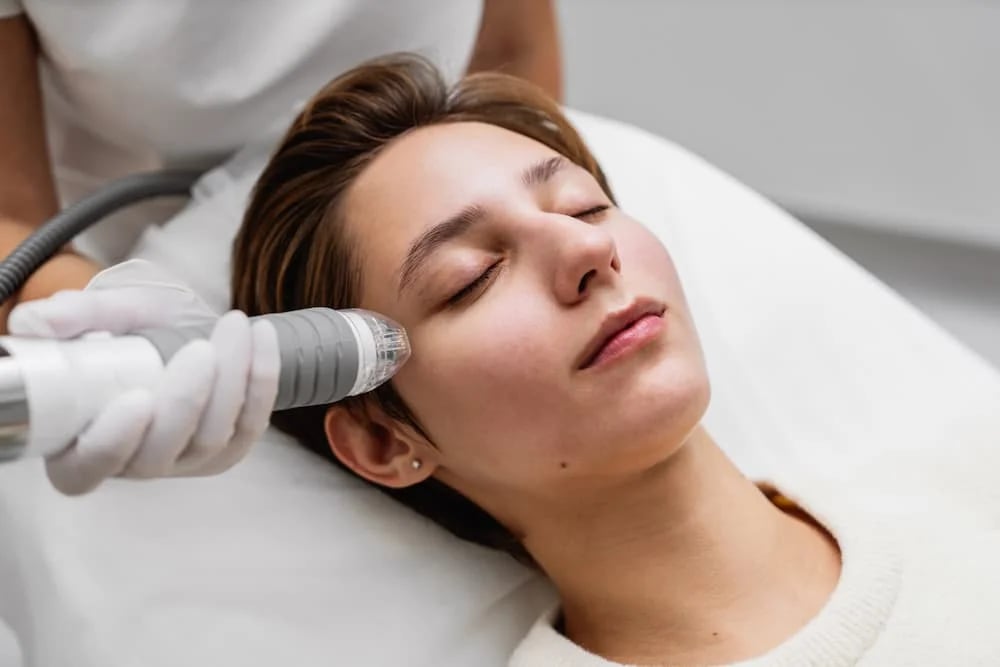
Radiofrequency microneedling combines two modalities. Needles puncture the skin to a chosen depth, creating a controlled wound that triggers healing, and radiofrequency energy delivered through those needles heats the deeper tissue at the tips. The heat contracts existing collagen and signals fibroblasts to produce more. The combination is more powerful for tightening than needling alone, because the energy reaches deeper than the mechanical injury would.
The practice describes its approach on the radiofrequency skin resurfacing page, and the aftercare steps are laid out in the RF microneedling recovery guide. In practical terms, a session involves numbing, a series of passes over the treatment area and a recovery period in which the skin looks like a mild sunburn with a grid of tiny marks. Redness and swelling typically settle over a few days, and a rougher, drier feeling follows as the surface renews. Most protocols call for a series of treatments spaced several weeks apart because collagen remodeling is slow and cumulative. Results continue to improve for months after the final session.
Who responds best? People with mild to moderate laxity and skin quality concerns tend to see the most visible change: fine crepey lines, enlarged pores, rough texture, early jowling and acne scarring. Crepey skin on the neck and lower cheeks is a classic target. Radiofrequency is also valued because it works on all skin tones when handled with appropriate settings, unlike some light-based tightening methods that can be risky for darker complexions. That said, outcomes depend on technique and settings, and a thorough consultation matters.
Compared with traditional microneedling, which relies on mechanical injury alone, the radiofrequency version delivers more tightening and is often chosen when the primary goal is firmness rather than texture and scarring alone. Traditional microneedling remains a fine option for acne scars, mild texture problems and collagen induction on a gentler budget of downtime.
What it will not do is lift a drooping jowl or reposition a descended cheek. It firms and refines. For many people that is exactly right, and for others it is only the foundation of a larger plan.
PDO threads: scaffolding for the layer below
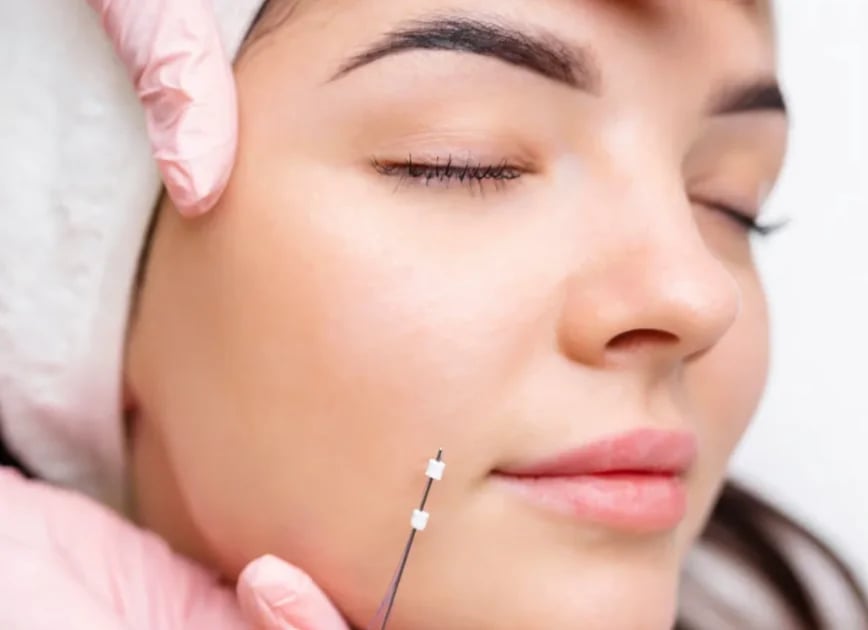
PDO threads are fine, dissolvable filaments made from polydioxanone, a material used in absorbable surgical sutures for decades. Placed in the subcutaneous layer through a tiny entry point, they provide a mild mechanical lift where the thread is anchored, and they trigger the body to lay down collagen around the filament as it slowly dissolves. The practice outlines the approach on its PDO thread lift service page, and the top five benefits of PDO thread lifts gives a patient-friendly summary.
There are different thread types for different jobs. Smooth threads placed in a mesh pattern primarily stimulate collagen and improve skin quality, often used for crepey areas, the neck and the lower face. Barbed or cogged threads have tiny anchors that grip tissue and lift it modestly, and they are used for jawline and cheek support. A skilled injector chooses the thread type, number and placement by examining how your tissue moves, not by a menu.
Recovery is real but manageable. Expect swelling, tenderness and occasional bruising, along with a pulling sensation when you smile or chew for a few days. Patients are generally advised to avoid vigorous facial movement, dental work and sleeping on their face for a short period. The PDO thread lift recovery timeline walks through the days and weeks in sequence, and the PDO thread aftercare guide covers what to do at home. Threads absorb over several months, while the collagen they stimulate persists longer. The lift is subtle compared with a surgical facelift, and honest providers describe it as a refinement, not a replacement.
The best candidates are people in their late thirties through fifties with early to moderate laxity, good skin elasticity and realistic expectations. Those with heavy jowls, significant excess skin or very thin skin are less suitable, because threads cannot support heavy tissue or fill deficits. Anyone who wants a dramatic transformation should hear clearly that threads produce a gentle change.
Sculptra: rebuilding structure from within
Sculptra is not a filler in the usual sense. Its active ingredient is poly-L-lactic acid, a biocompatible substance that works by stimulating the body’s own collagen production over time. When injected into the deep layers, it acts as a signal, and the visible result develops gradually over several weeks as new collagen forms. Because the improvement comes from the body’s own tissue, the results look soft and natural, and the effect can last a long time. The Sculptra service page describes the treatment, and the guide to how long Sculptra lasts goes into maintenance and longevity.
The key conceptual difference between Sculptra and a hyaluronic acid filler is that Sculptra restores support and thickness progressively, while a hyaluronic acid filler restores volume immediately. The Sculptra compared with dermal fillers page lays out those differences in detail. This is why Sculptra is often recommended for the generalized, flattened, slightly deflated look of the mid and lower face, where the issue is gradual thinning rather than a single hollow.
Tightening here is indirect. Sculptra does not contract skin like radiofrequency does, but by rebuilding the collagen and volume that support the overlying skin, it can improve firmness and reduce the look of sag. It is also used for body areas where skin has thinned. Treatment typically involves a series of sessions spaced a few weeks apart, with massage instructions afterward. Patience is required, because the result is not visible on the day, and a patient who expects an immediate lift will be frustrated.
Candidates include people in their thirties through sixties with early volume loss, fine skin laxity and a preference for subtle improvement. It is less suited to someone who wants an immediate result for an event next week, in which case a conventional filler is a better tool.
Where fillers and Kybella fit, and where they do not
Because the word tightening gets used loosely, it is worth being precise about two other treatments people reach for. Hyaluronic acid fillers do not tighten skin. They add volume, and by adding volume in the right place they can make skin look smoother and less saggy, particularly in the cheeks, temples and jawline. The practice’s dermal filler options and its injectables menu cover the range. Used well, fillers lift by supporting, not by contracting. Used carelessly, particularly in someone with excess skin, they can add weight and make sagging worse.
Kybella addresses a different issue entirely. It is an injectable that dissolves submental fat, the pocket under the chin. For someone whose jawline blurs because of a fat pad rather than loose skin, it is a genuine contour improvement. But when the chin area is soft because of lax skin, removing fat may leave extra skin behind. The Kybella treatment page explains how candidacy is determined. In a plan, it pairs naturally with a tightening treatment: reduce the fat, then tighten the skin that remains.
SkinVive, a newer injectable, is worth a sentence because it comes up in searches for skin quality. It is designed to improve the smoothness and hydration of the skin from within, and it targets texture rather than structure. It is a quality treatment, not a tightening one, and it can complement the approaches above for people who mainly want a smoother look.
A simple way to match your concern to a starting point
Rather than choosing a device, start with what you saw in the pinch test. If your skin is crepey and fine but the contour is intact, radiofrequency microneedling is usually the logical start. If the contour has dropped slightly, especially along the jaw and cheek, threads can add support, with collagen-building treatments underneath. If the face looks flat and thin, with early hollows, Sculptra is a strong foundation. If the jawline is soft because of a small fat pocket, Kybella addresses the pocket and tightening treatments address the skin.
Most people have more than one of these going on. That is why combination plans are common. A typical sequence might begin with radiofrequency to improve skin quality over a series of sessions, then add Sculptra to rebuild structure, then use threads or fillers for targeted support. The spacing guide for combined treatments sets out how far apart different services should be placed, because stacking energy-based treatments, injectables and threads too tightly can increase swelling and complicate healing. Plans are built in order of what supports the others, with skin quality and structure first and fine-tuning last.
What the timeline really looks like
Non-surgical tightening is a slow discipline, and understanding the calendar prevents disappointment. Radiofrequency microneedling brings a few days of visible recovery, a gradual smoothing over four to six weeks, and further improvement over the following months as collagen remodels. Threads give an early lift that is partly swelling and settles after a week or two, followed by the more lasting effect over the next few months. Sculptra shows little on the day, then builds over weeks, and the result is often best judged at a couple of months after the series.
This means a rational plan starts well before an important date. A wedding, a reunion or a milestone birthday calls for starting treatment three to six months earlier, not three weeks. For events nearer than that, a conservative filler or a facial is a better short-term tool, and the tightening series can start afterward.
It also means photographs matter. Taking standardized photographs before the first session, in the same light and from the same angles, is the only reliable way to judge gradual change. Memory and mirrors are poor judges of slow improvement, and many patients are surprised by how different the before pictures look.
What changes by decade, and what that means for timing
Tightening needs look different at different ages, and the most common mistake is treating a forty-year-old face like a sixty-year-old one, or the reverse. In the late twenties and thirties, the goal is usually prevention and quality. Collagen is still plentiful, laxity is minimal, and the best investments are sun protection, a retinoid, and occasional collagen-stimulating treatments such as traditional microneedling or a light radiofrequency series if texture or early crepiness bothers you. Threads and Sculptra are rarely needed this early unless there is a specific structural concern.
In the forties the first real shifts appear. The jawline begins to soften, the nasolabial folds deepen, and the skin on the neck loses its snap. This is the decade in which radiofrequency microneedling earns its keep, and where Sculptra often becomes useful as volume loss begins. Threads can support early jowling. Plans in this decade tend to be gentle, and results are the most natural because the tissue still responds well.
In the fifties, particularly around and after menopause, the pace picks up. Collagen loss accelerates, the face loses volume in the midface and temples, and the neck often shows bands and crepey skin. Combination plans are the norm: radiofrequency for skin quality, Sculptra to rebuild support, and targeted fillers or threads for structure. This is also the decade in which an honest conversation about surgery becomes more relevant, because some faces have crossed the line where non-surgical treatments are a good supplement rather than a substitute.
In the sixties and beyond, surplus skin is usually the dominant feature. Non-surgical treatments still have value, especially for skin quality, comfort with the result and for people who cannot or prefer not to have surgery, but expectations should be calibrated to modest, real improvements. A patient in this group who understands that goal is often very satisfied. A patient who expects a surgical result is not.
Beyond the jawline: neck, cheeks and the places people forget
Most tightening conversations begin with the jawline, but the places that bother patients most are often elsewhere. The neck ages quickly because its skin is thin, it has fewer oil glands, and it moves constantly. Crepey texture and horizontal lines respond reasonably well to radiofrequency microneedling and to smooth threads placed in a fine mesh, while vertical bands caused by the platysma muscle are a structural issue that neuromodulators and surgery address more directly. The cheeks, where skin thins and flattens, respond well to the combination of collagen stimulation and careful volume replacement.
The area around the mouth and the lower eyelids deserve a note of caution. Skin here is delicate, and aggressive energy or poorly planned filler can cause problems that are harder to correct than the original concern. Providers who treat these zones tend to use lower settings and smaller volumes and to build results in stages. If a clinician is eager to treat everything at once and to push intensity, that is a reason to slow down.
Hands, chest and body skin are a separate chapter. They respond to some of the same principles, particularly collagen stimulation, but depth, settings and expectations differ, and not every device or injectable is appropriate everywhere. Ask specifically whether an area is part of what the practice treats and what results to expect before booking.
Realistic expectations, said plainly
The most important paragraph in any article on non-surgical tightening is the one about limits. These treatments improve firmness, texture, support and contour. They do not produce the result of a facelift, and anyone who promises otherwise is selling something. The degree of improvement depends on starting laxity, skin quality, age, sun history, smoking, weight changes and how consistently the plan is followed.
A person with mild to moderate changes and good skin can see an impressive and natural improvement that delays or in some cases removes the need for surgery. A person with advanced laxity, heavy jowls and abundant loose skin will see a modest effect, and a good provider will say so at the first visit rather than after the third session. Being told honestly that surgery is the better route is a sign of a careful practice, not a failed consultation.
Ongoing care also matters. Daily sunscreen is not optional in a city with this much sun, because ultraviolet exposure breaks down the collagen you are trying to build. A skincare routine with an appropriate retinoid, antioxidant and moisturizer supports the work. Weight stability helps, since repeated loss and gain stress the skin. And maintenance treatments are part of the plan, because collagen declines continue throughout life.
Safety, side effects and who should wait
Every one of these treatments has risks that deserve a plain mention. Radiofrequency microneedling can cause temporary redness, swelling, dryness and, less commonly, pigment changes or infection, particularly in people prone to hyperpigmentation or with poor aftercare. Threads can cause bruising, asymmetry, visible dimpling, thread migration or extrusion and infection. Sculptra can cause nodules or lumps if placed too superficially or not massaged as directed, which is why technique and aftercare adherence matter. Injectables in general carry rare but serious risks such as vascular complications.
Some people should wait or choose a different route. Active skin infections, cold sores in the treatment area, autoimmune conditions in an active phase, pregnancy and breastfeeding, recent isotretinoin use, bleeding disorders and unrealistic expectations all deserve discussion. Metal implants, pacemakers or other devices near the treatment area can matter for radiofrequency. A thorough medical history before treatment is not paperwork for its own sake.
Experience counts here. A provider who has performed hundreds of threads, injected Sculptra regularly and understands facial anatomy will place treatments more safely than someone who has done a few. The practice’s aesthetic nurse injector, Jana Dreebin, brings more than two decades of experience working alongside plastic surgeons and training through the Allergan Medical Institute, which is the kind of background worth asking about wherever you book.
Questions worth asking before you book anything
A short list of questions separates a considered consultation from a sales pitch. Which layer do you think is responsible for my sag, and how did you decide? What can this treatment realistically do for me, and what can it not do? How many sessions will I need, and how will we judge progress? What are the risks specific to my skin tone, my history and my medications? What does recovery look like in the first week, and when can I return to my normal routine? And what would you recommend if you were not allowed to sell me this particular treatment?
The last question is a useful test. A good clinician will answer it plainly and may suggest waiting, trying something simpler, or considering surgery. The aim is not to find the most dramatic treatment, but to find the one that fits your face, your calendar and your tolerance for downtime.
Bringing it together
Skin tightening in Phoenix does not have to mean choosing a device from a list of names. Think in layers: radiofrequency for skin quality and early laxity, threads for mild support, Sculptra for gradual rebuilding, fillers for immediate volume, Kybella for a fat pocket, and sunscreen and skincare for everything. Most good plans use two or three of these in sequence, spaced sensibly, with photographs to measure progress and an honest conversation about limits.
If you are not sure which layer is your main problem, that is exactly what a consultation is for. You can schedule a consultation to be assessed in person, review your photographs and leave with a plan that matches what you want to change and what is actually achievable without surgery.
Frequently Asked Questions
What is the best non-surgical skin tightening treatment?
There is no single best option, because sagging has several causes. Radiofrequency microneedling is often chosen for crepey, lax skin, PDO threads for mild contour support, and Sculptra for gradual rebuilding of volume and collagen. The best choice depends on which layer is responsible for your concern.
How many sessions of RF microneedling will I need?
Most protocols use a series of treatments spaced several weeks apart, because collagen remodeling is gradual. The exact number depends on your skin, your goals and the area treated. Your provider will outline a plan after examining you and will adjust it based on your response.
How long do PDO threads last?
The threads themselves dissolve over several months, but the collagen they stimulate can persist longer. The visible lift is subtle and tends to soften over time, so many people repeat treatment periodically. Individual results vary with age, skin quality and lifestyle.
Is Sculptra the same as filler?
No. Sculptra contains poly-L-lactic acid and works by stimulating your own collagen production over weeks, rather than adding immediate volume like hyaluronic acid fillers. Results develop gradually and can last a long time, but it requires a series of sessions and patience.
Can I combine RF microneedling, threads and Sculptra?
Yes, many plans combine them, but timing matters. Treatments are usually spaced so that swelling and healing do not overlap, and the order is chosen so that skin quality and structure come first. Your provider will set the sequence and intervals for your situation.
Will non-surgical tightening replace a facelift?
For mild to moderate laxity it can delay or reduce the need for surgery, but it does not reproduce a facelift. Significant excess skin and deep sagging can only be corrected surgically. An honest consultation will tell you which category you fall into.
What is the downtime for these treatments?
Radiofrequency microneedling typically brings a few days of redness and swelling. Threads involve swelling, tenderness and possible bruising for a week or so. Sculptra usually has little downtime beyond mild swelling and bruising at injection sites. Individual recovery varies.
Does skin tightening work on the neck?
Often yes, to a degree. Radiofrequency microneedling and smooth threads are commonly used for crepey neck skin, and Kybella can address a fat pocket under the chin. Significant neck banding or excess skin may require surgery for a full correction.
Are these treatments safe for darker skin tones?
Radiofrequency microneedling is often a good choice across skin tones when settings and technique are appropriate, but any treatment that injures skin carries a risk of pigment change. Share your history of dark marks or scarring so your provider can plan accordingly.
When will I see results?
Radiofrequency microneedling improves skin gradually over weeks to months. Threads show an early lift that settles, followed by lasting improvement. Sculptra builds over several weeks and is best judged at about two months. Photographs help track change.
Who should not have these treatments?
Pregnant or breastfeeding patients, people with active infections or cold sores in the area, certain autoimmune or bleeding conditions, and those with implanted devices near the treatment site may need to wait or choose alternatives. A full medical history review is part of every consultation.
How do I protect the results?
Wear sunscreen daily, avoid smoking, keep weight reasonably stable and follow the skincare routine your provider recommends. Plan maintenance treatments as advised, since collagen declines continue with age and sun exposure.