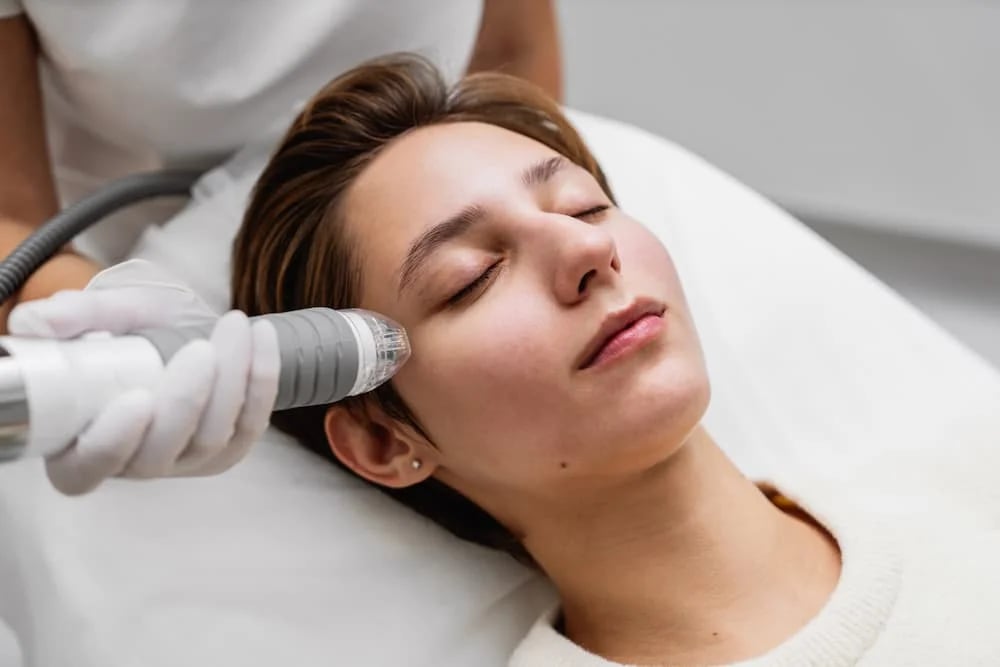
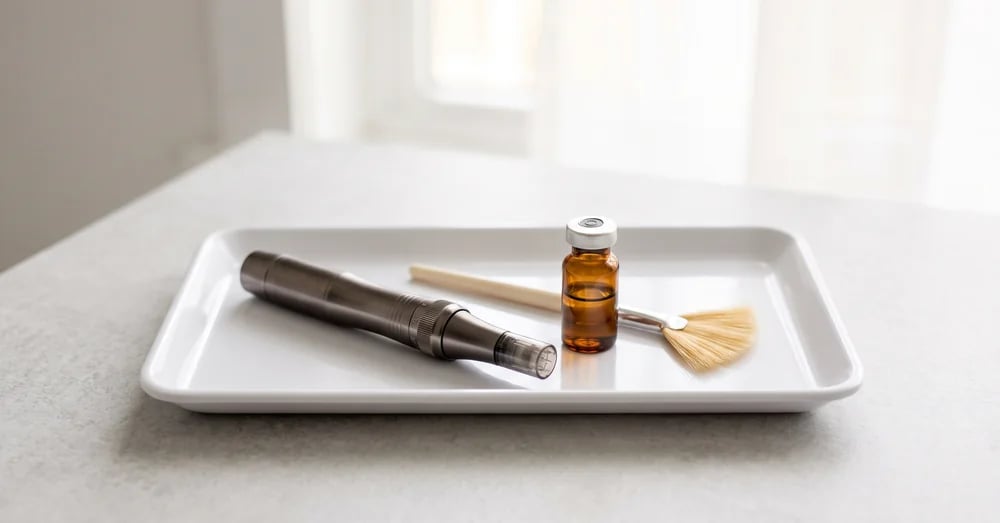
From the outside, the two treatments look almost identical. A numbing cream goes on, a handheld pen glides across the face, the skin turns pink, and the patient leaves with a story about a tingling sensation. The difference is invisible and sits a few millimeters below the surface. One treatment uses needles alone. The other sends radiofrequency energy through the needles into the deeper layer of skin, so that heat does part of the work.
That single difference changes who benefits most, how many visits it takes, what the days afterward look like, and which people should wait. It also explains why “microneedling” and “RF microneedling” are often used as if they were the same thing, even though they behave quite differently in practice. People searching for one are frequently better served by the other, and some are best served by neither.
This guide walks through how each works, which concerns fit which tool, how sessions and recovery compare, and what patients typically need to know before booking. It is based on the treatments offered at Ageless Health Institute in Phoenix, where the team offers both, and it is written to help patients arrive at a consultation with better questions.
What needles alone actually do
Standard microneedling is a controlled, shallow injury. A pen holds a cluster of very fine needles that move rapidly up and down, creating thousands of microscopic channels in the skin. The channels close within hours, but the body reads them as damage and responds as it would to any wound.
The response unfolds in phases. First comes a brief burst of inflammation, which sends signals that call repair cells to the area. Next, fibroblasts, the cells that build the skin’s framework, become active and begin producing new collagen and elastin. Finally, over weeks to months, the new collagen is remodeled and organized into a stronger, smoother structure. The visible effect is not instantaneous, and most patients notice a gradual improvement in texture, tone and firmness in the weeks that follow.
Depth matters. On the face, shallow settings treat fine lines, mild irregularity and surface texture. Deeper settings reach areas where scars are anchored, and they are used with greater caution and with more numbing. The treatment is mechanical, with no heat, which is one reason it is considered gentle for many skin tones. The Eclipse MicroPen is an example of this type of device, and it is the one the practice uses for its needling service.
The concerns that standard microneedling sessions address include fine lines, uneven texture, enlarged pores, acne and surgical scars, stretch marks, mild to moderate laxity and sun damage. The channels also temporarily make the skin more receptive to topical products, a feature that deserves a word of caution later in this article.
What heat adds
RF microneedling keeps the needles but changes what happens at their tips. The needles are designed to deliver radiofrequency energy into the dermis as they enter the skin. The energy produces a small, controlled zone of heat around each needle, below the surface where the skin’s structural proteins live.
Heat does two things that needles alone cannot do. First, it causes existing collagen fibers to contract, which creates a modest tightening effect that starts soon after treatment. Second, it produces a controlled thermal injury that triggers a stronger and more targeted remodeling response, with new collagen and elastin forming over the following months. Because the energy is released in the dermis and not on the surface, the outer layer of skin can be spared more than it would be with a surface laser.
At Ageless Health Institute this treatment is offered as radiofrequency resurfacing, branded as Pixel RF, and it combines radiofrequency energy with microneedling to deliver more pronounced tightening and texture improvement than needling alone. It can be used on the face and neck, and on body areas including the arms, abdomen, back and thighs, where skin laxity and stretch marks are a common concern.
A fair way to summarize the distinction is that needles alone mostly refresh and remodel, while needles with heat also tighten. That is a simplification, because needling alone does improve firmness over time and RF improves texture, but it is a helpful starting point for deciding where to begin.
Matching the concern to the tool
Most patients arrive with a concern and not a device in mind. These are the most common concerns, and how each tool tends to fit them.
Fine lines and early crepiness respond well to either. A patient in her thirties with lines around the eyes and a slightly rough texture will often do well with needling alone, in a series, and may never need heat. A patient in her fifties with the same lines, plus visible looseness along the jawline, might find that RF delivers more of what she wants.
Enlarged pores and general texture tend to be a needling concern. The collagen remodeling that results from a series can make pores look tighter and the skin look more even. Heat is not essential here, though it may add to the effect for some.
Acne scars are the topic most patients ask about. Rolling and shallow boxcar scars, where the skin looks dimpled because bands of tissue anchor it down, respond to both approaches, and many people see a meaningful change across a series. Deep, narrow ice pick scars generally respond less. Scar treatment is where combinations are common, and an honest provider explains how much improvement is realistic for each scar type.
Skin laxity is where RF earns its place. If the main complaint is looseness, whether along the jawline, under the chin, on the neck, or on the upper arms and abdomen, a tool that tightens as well as remodels is the more logical choice. Even so, RF microneedling is best for mild to moderate laxity. Heavy sagging calls for something more structural, such as PDO threads, volume replacement, or in some cases a surgical conversation.
Stretch marks respond slowly and modestly to either treatment. Newer, red or pink stretch marks tend to respond better than older, white ones. The realistic expectation is gradual change, not erasure.
Surgical and traumatic scars may benefit from both, depending on their age and thickness. Providers typically ask when the scar formed, because very recent scars are usually left to mature first.
Discoloration is where a careful provider hesitates. Sun spots and general pigment irregularity are often better treated with light-based treatment or peels, and IPL photofacial is usually the better first step when pigment or redness is the primary concern. Melasma needs special mention because heat can make it worse in some people. Patients with melasma are usually steered toward gentler melasma treatment options before any energy device is considered.
Skin tone, sun and the question of candidacy
Both treatments are described as suitable for a wide range of skin tones, and for needling alone that is a reasonable starting statement because there is no heat to provoke pigment change. Still, any procedure that injures the skin can leave temporary darkening in people who are prone to it. Candidacy and settings are decided at consultation, not on a website.
For RF, tone matters more because heat can stimulate pigment cells. Providers adjust energy, needle depth and spacing based on skin type, and some patients with a history of pigment trouble start with test areas or with needling alone. A sensible question for any provider is how the treatment is adapted for a given skin tone and what the approach to melasma and post-inflammatory darkening is.
Sun exposure is the other variable, and Phoenix presents a particular challenge. Tanned skin, fresh sunburn and recent sun exposure all raise the risk of uneven results, and patients are asked to avoid sun and tanning before treatment. A summer of golf and pool days can quietly rule out a season for aggressive treatments. A later section covers how that plays out across a Phoenix year.
Sessions, spacing and what the calendar looks like
Because both treatments work through the skin’s own repair process, they need time. A single session produces some change, but most patients see their best results from a series.
For standard microneedling, the practice’s protocol is three to six sessions about four to six weeks apart, with maintenance sessions every few months. Each visit takes roughly thirty to sixty minutes including numbing. For radiofrequency resurfacing, the protocol is about three to five sessions about four to six weeks apart, with maintenance every six to twelve months. Some patients notice improvement after a single session, particularly in tightness and glow, but collagen continues to remodel for months afterward.
The spacing is not arbitrary. Skin needs several weeks to complete the remodeling phase before it is ready for another controlled injury. Booking sessions too close together does not speed results and can irritate the skin. Planning matters more than speed. For a patient with an event in four months, the sensible approach is to work backward so that the last session falls at least a few weeks before it, while the skin has had time to settle.
The final result of a series is usually judged three to six months after the last session, because the full effect of collagen remodeling develops gradually. Photographs taken at each visit under the same lighting are the best way to see progress that is difficult to notice in the mirror.
The days after: what recovery looks like
Downtime is what many people are really asking about when they search for these treatments. The honest answer is that both are modest, and RF is a little more demanding.
After standard microneedling, the face is typically pink, like a mild sunburn, for a day or two. Tightness and dryness are common, and some light flaking can follow for a few days. Many patients return to work the next day, with makeup allowed once the skin feels comfortable, usually after a day or so depending on the provider’s guidance.
After RF microneedling, redness and a warm, sunburn-like sensation are typical for the first twenty-four to forty-eight hours, and swelling is possible, especially in the first two days. The skin may look pink for several days, with dryness and flaking in the middle of the first week. The first day or two is when redness and tightness are most noticeable, makeup becomes possible around day three, and most visible effects settle by about day seven, as described in the practice’s RF recovery timeline. Small pinpoint crusts can appear in some people and should be left alone to shed on their own.
For both treatments, the aftercare principles are the same. Gentle cleansing, a simple moisturizer and daily broad-spectrum sunscreen matter more than any special product. Heat, sweat and friction are best avoided for a day or two, which means postponing hot yoga, saunas and hard workouts. Active ingredients such as retinoids and exfoliating acids are typically paused for several days or until the provider says it is time to resume. Picking at flakes or crusts is the single quickest way to turn a smooth recovery into a spotty one.
For patients planning around a social calendar, treatment works best when the first four to five days fall on a quiet stretch. A Friday session works for many people who want to be presentable by Wednesday. For bigger events, the safest approach is to complete treatment well in advance, because the skin often looks its best after the early redness fades and the new collagen begins to show.
Who should wait, and what to tell the provider
A short list of situations calls for extra care or a delay, and each is worth mentioning at the consultation even when a patient is unsure it matters.
Recent isotretinoin use is the first. Providers commonly ask patients to wait several months, sometimes longer, after finishing the medication before undergoing treatments that injure the skin, because healing can be altered. Active acne, open lesions, cold sores and skin infections in the treatment area usually need to clear first. Patients who get cold sores may be offered a preventive medicine, since the injury can trigger an outbreak.
Pregnancy is another reason to wait. A tendency to form thick or raised scars, called keloid or hypertrophic scarring, is a reason for caution. Autoimmune conditions, blood-clotting disorders and blood thinners warrant discussion. For radiofrequency specifically, implanted electronic devices such as pacemakers and metal implants in the treatment area are usually reasons not to proceed.
Recent sun exposure, tanning and self-tanner should be disclosed. So should retinoids, exfoliating acids and photosensitizing medicines, which are often paused before treatment. A history of melasma or easy darkening after injury changes the plan, and sometimes the tool.
None of these is meant to discourage anyone. They are the reasons a consultation exists. A good provider uses the answers to choose a safer, more effective plan, not to talk a patient out of treatment.
Adding PRP or exosomes: what the extras really do
Microneedling is often offered with add-ons, and it helps to know what they are.
Platelet rich plasma, or PRP therapy, is made by drawing a small amount of the patient’s blood and spinning it to concentrate the platelets, which carry growth factors. When it is applied to the skin during needling, the idea is that it supports healing and enhances the collagen response. The practice offers a PRP enhanced version of the MicroPen treatment, sometimes called a vampire facial. Some studies suggest a modest additional benefit for scars and texture, and results vary from person to person.
Exosomes and related products are newer. They are tiny signaling particles that are applied to the skin after needling in some practices, with the aim of calming inflammation and supporting repair. The research is early, and the regulatory picture is complicated, so the right questions are what exactly is being used, how it is sourced, and what the clinic can honestly say about it.
One caution applies to every add-on. Because the channels left by needling are open for a short window, only sterile, professional-grade products should be applied to the skin during that time. Patients should not apply their own serums, oils or home skincare right after treatment, and should not allow any provider to apply a product that cannot be explained.
Needling alongside peels, IPL, fillers and facials
Most patients use more than one treatment, and the order matters.
Needling and chemical peels both stimulate renewal, so they are typically spaced apart rather than stacked, with the schedule set by the provider. The practice’s VI Peel comparison explains how they differ, with peels working from the surface down and needling from within. Light-based treatments such as IPL are generally separated by several weeks as well.
Injectables follow their own logic. Filler restores volume that no amount of collagen stimulation will bring back, and many patients use it alongside a needling series, often with the filler placed first or at a separate visit. Dermal fillers and needling treat different problems, and combining them can produce a more complete result. Facials such as DiamondGlow or a Hydrofacial are well suited to the weeks between sessions, once the skin has settled.
The principle behind all of this is to treat in layers and give each layer time to heal, which the practice lays out in its guide to treatment spacing.
Planning around a Phoenix year
Timing deserves more thought in the desert than it does in most places. From late spring through early fall, daily sun exposure is hard to avoid, and even a brief walk to the car can add up on freshly treated skin. Treated skin is more vulnerable to pigment changes, which is why many patients book their series in the cooler months, roughly October through April, when hats, shade and indoor routines are easier to keep up.
That does not make summer treatment impossible. It means the plan changes. Sessions are timed so that the first week after each visit falls on days with little outdoor time, sunscreen is reapplied more often, and RF is approached more conservatively for anyone with a tan or a history of uneven pigment. Patients who spend winters elsewhere or travel often should tell the provider early, because a series interrupted by long gaps is harder to judge.
Beyond the face: neck, chest, hands and body
The neck and chest have thinner skin and fewer oil glands than the face, which makes them slower to heal and quicker to show sun damage. Crepey texture and horizontal neck lines are common reasons for treatment, and both tools are used there, usually with more conservative settings and more spacing between visits. The first few days tend to feel tighter and look pinker than they did on the face.
Hands age early, and the backs of the hands lose volume and gain spots long before most people notice. Needling can improve texture, and light-based treatment is usually better for spots. Body areas such as the abdomen, upper arms and thighs are where RF is most often chosen, because the concern there is typically looseness and stretch marks, and larger areas take longer to treat and can feel more tender. It is reasonable to ask how long a body session runs and whether numbing is applied to the whole area.
What a good treatment plan looks like on paper
A trustworthy plan is specific. It names the concern being treated, the device and the reason for choosing it, the number of sessions as a range, the interval between them, and the point at which the plan will be reviewed. It also says what is not being promised. A provider who describes a single treatment as fixing everything, or offers an identical package to every patient, deserves a second look.
Good plans also leave room for other tools. A patient with scarring and uneven tone may do best with a needling series alongside a course of chemical peels, spaced so that each one has time to heal. A patient with looseness and volume loss may need RF now and filler later. The sequence is part of the plan, and it should be written down, because it is easy to forget in month three what was supposed to happen in month four.
Review points matter as much as the first visit. After the second session, the patient and provider should look at photographs together and decide whether to continue as planned, change settings, add a different treatment or stop. Stopping is a legitimate outcome when the skin has improved enough.
Common myths worth setting aside
A few ideas circulate often enough to be worth correcting. One is that more redness means a better result. It does not. Redness reflects inflammation, and the quality of the outcome depends on depth, spacing and healing, not on how pink the skin looked on the way out of the office.
Another is that RF microneedling is simply a stronger version of microneedling and therefore always better. It is a different tool, and for a thirty year old with texture concerns it may be more than is needed. A third is that results appear within days. Early glow is real, but collagen takes months to build, and judging a series by week one leads to disappointment or to unnecessary extra sessions.
Questions worth asking at a consultation
A few questions reveal a great deal about a provider and a plan. Which device will be used, and why that one for this concern? How many sessions should be expected, and how will progress be judged? What will the skin look like on day two and day seven? How is the treatment adjusted for skin tone? What should be avoided before and after? What happens in the event of a reaction? Are photographs taken at each visit?
It is also worth asking whether needling is the right first step at all. Sometimes the best answer is a different treatment, or a sequence that starts with one tool and adds another. Patients who want to work through those questions can book a consultation with the team at Ageless Health Institute, located at 20616 N. Cave Creek Rd, Suite B-110, in Phoenix.
The takeaway
One sentence carries most of the decision: needles alone suit the goal of refreshing texture, pores and mild scarring, and needles with heat deserve consideration when looseness is part of the picture, provided skin tone, medical history and sun exposure make it a good fit. Everything else, from the number of sessions to the timing around a calendar, flows from that choice.
Patients who are still unsure after reading can bring their questions, a medication list and a few photographs of how the skin looks without makeup. Those three things give a provider far more to work with than a product name, and they make it easier to say whether needles, heat, a different treatment or simply a better sunscreen routine is the right place to start. Skin changes slowly, so a steady, well spaced plan almost always beats a rushed one.
Frequently Asked Questions
What is the difference between microneedling and RF microneedling?
Microneedling uses fine needles alone to create tiny channels that trigger collagen production. RF microneedling adds radiofrequency energy through the needles, which heats the deeper skin to tighten it and stimulate a stronger remodeling response.
Which is better for skin tightening, microneedling or RF microneedling?
RF microneedling is generally better for mild to moderate laxity because the heat contracts existing collagen and stimulates new collagen. Needling alone improves firmness more gradually and is often chosen for texture and pores.
Which one is better for acne scars?
Both can improve rolling and shallow boxcar scars across a series of sessions, while deep, narrow ice pick scars respond less. A provider assesses the scar types and advises which approach, or combination, makes sense.
How many sessions are usually needed?
The practice’s protocols describe about three to six sessions for microneedling and about three to five for radiofrequency resurfacing, spaced roughly four to six weeks apart. The provider sets the final plan after assessing the skin and goals.
How much downtime should be expected?
Microneedling usually causes pinkness for a day or two with mild dryness. RF microneedling tends to cause redness and warmth for twenty-four to forty-eight hours, possible swelling, and flaking for several days, and most people return to normal activities within a day or two.
Can makeup be worn afterward?
Makeup is usually possible once the skin feels comfortable, often after a day or so for microneedling and around day three for RF. Patients should follow the provider’s instructions and use clean brushes.
Is RF microneedling safe for darker skin tones?
It can be, but heat can stimulate pigment cells, so providers adjust energy, depth and spacing and may start with a test area. Candidacy is decided at consultation, especially for patients with a history of melasma or darkening after injury.
Can patients with melasma have these treatments?
Heat can aggravate melasma in some people, so RF is approached with caution or avoided. Alternatives such as specific peels and pigment-focused plans may be better first steps, and the history should be discussed before booking.
Who should wait before microneedling?
Patients who recently took isotretinoin, are pregnant, have active acne, cold sores or infection in the area, a tendency toward keloid scarring, or recent sunburn or tanning should discuss timing. Pacemakers and certain metal implants also matter for RF.
How long do results last?
Collagen remodeling continues for months after a series, and results can last a year or more with sun protection and good skincare. The practice suggests maintenance sessions every few months for microneedling and every six to twelve months for radiofrequency.