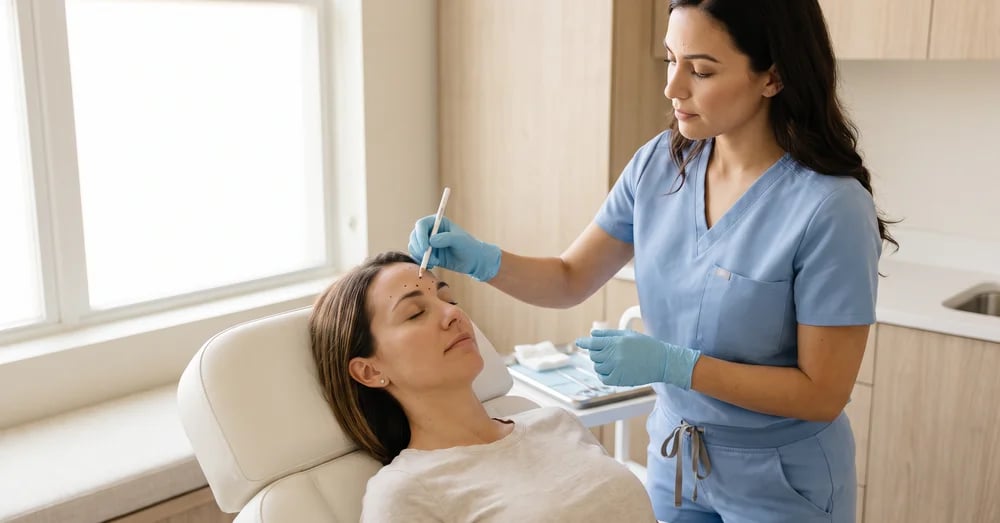
Patients who ask about Jeuveau usually arrive with one of two questions. Some have heard the name from a friend or seen it on a menu and want to know what it is. Others have been treated with another neuromodulator for years, have noticed their results are not quite what they used to be, and wonder whether switching products would help.
Both questions are reasonable, and the honest answer to both is more nuanced than the marketing around brand names suggests. Jeuveau is a legitimate, approved neuromodulator that belongs to the same family as Botox, Dysport and Xeomin. It works in the same basic way. The differences between the products are real but smaller than most people expect, and the factors that decide whether a result looks natural and lasts have far more to do with the injector, the plan and the patient’s anatomy than with the label on the vial.
This guide explains what Jeuveau is, what it is approved to treat, how it relates to the other products in the category, what to expect during and after treatment and how to make a sensible choice. It is written for adults in the Phoenix area who want clear information without a sales pitch, and it reflects the approach of the clinical team at Ageless Health.
What Jeuveau is, in plain terms
Jeuveau is a brand name for a botulinum toxin type A product. In the United States it is approved by the Food and Drug Administration for the temporary improvement in the appearance of moderate to severe frown lines between the eyebrows, called glabellar lines, in adults. It reached the market in the late 2010s, which makes it newer than Botox and Dysport but not new in the sense of being experimental.
Like its relatives, it works by temporarily blocking the signal between nerves and certain muscles. When the muscle that pulls the skin into a frown is relaxed, the overlying lines soften. The effect is reversible: as the nerve endings recover, the muscle gradually regains movement, and the lines return over a period of months.
You may hear the product called a neuromodulator, a neurotoxin, a wrinkle relaxer or simply by one of the brand names. They all point to this category of treatment. Jeuveau is the newer product, while Botox is the older and more widely known option.
What it treats, and what is “off label”
The approved use is frown lines between the brows. That is the indication for which the manufacturer ran its clinical trials and received approval.
These uses are common and clinicians widely consider them reasonable, but they go beyond the specifically approved indication of any single product, and the term for that is off label. Off label use is legal and routine in medicine, and it simply means the clinician is applying judgment beyond the text of the approval.
A patient should expect a clinician to be straightforward about this distinction and about which areas make sense for her face.
How Jeuveau relates to Botox, Dysport and Xeomin
This is the part of the discussion that attracts the most myth, so it helps to be careful.
All four products are botulinum toxin type A. Each is made by a different company using its own manufacturing process and formulation, and each has its own dosing units. Botox is made by one company, Dysport by another, Xeomin by a third and Jeuveau by a fourth. The same framework applies to how Dysport and Xeomin compare with Botox, and Jeuveau fits into it.
Same mechanism, different formulations. The active ingredient does the same job in the same way. What differs is the surrounding formulation, the protein complex, the manufacturing method and the way potency is measured.
Units are not interchangeable. Each manufacturer defines its units differently, so a number quoted for one product tells you little about another. A patient who says “I always get this many units” cannot directly translate that to a different brand. This is why a switch should be managed by an injector who knows how to adjust, and why comparing prices per unit across products can be misleading.
Onset and duration are broadly similar, with individual variation. Some people report that one product seems to work faster or last longer for them than another. Studies comparing the brands head to head are limited, and individual response varies considerably, so it is wise to treat such claims as impressions and not rules.
Spread and precision are discussed but hard to prove. Injectors sometimes describe differences in how a product diffuses from the injection point. These differences may be real or may reflect technique, dilution and anatomy more than the brand. A skilled injector adapts the approach to the product in hand.
Price differences exist, but vary. Some practices price a newer product differently, often to attract patients. Because units differ, the sensible comparison is the total cost of an equivalent treatment for the same result, not the cost per unit.
The practical lesson is that choosing among these products is rarely the most important decision. The injector’s skill, the treatment plan and the follow up matter more.
Why someone might choose Jeuveau
Patients choose it for a handful of reasons, and it helps to see them honestly.
A patient may have heard good things from a friend and want to try it. A patient may be switching because she feels her current product has become less effective, a perception some people have, whether because the results have changed, expectations have shifted or her face has aged. A patient may be looking for a more favorable price. Or a clinic may simply prefer it for certain treatments based on its experience.
None of these is a bad reason. A trial of a different product can be sensible, particularly if you are dissatisfied. But it is better to make the change with an injector who can explain the reasoning, document the dose and review the outcome, so you learn whether the change helped.
Who is a good candidate
Neuromodulator treatment suits most healthy adults who want to soften expression lines. Several features make a patient a particularly good candidate: lines that are mainly caused by muscle movement, realistic expectations, general good health and a willingness to maintain treatment over time.
Situations that call for caution or a different plan include pregnancy and breastfeeding, which are generally reasons to wait, neuromuscular conditions such as myasthenia gravis, active skin infection at the injection sites and a known allergy to any ingredient in the product. Patients taking certain medications, including some antibiotics that affect neuromuscular transmission, should discuss them. Anyone with a history of reaction to a botulinum toxin product should say so.
It is also worth saying that not every line is a good target. Deep lines etched into the skin by years of movement and sun damage may only soften partially with a muscle relaxant, and may do better with a combination of treatments such as skin resurfacing or fillers. How neuromodulators fit with other options comes down to combining treatments and spacing them sensibly.
What to expect at a Jeuveau appointment
A thoughtful visit follows a clear structure.
Assessment. The clinician examines your face at rest and in motion, asking you to frown, raise your brows and squint. This shows how your muscles work, where lines form and whether there is asymmetry. Photographs are taken for documentation.
Plan. The injector explains which areas to treat, what the likely effect will be and what the limitations are. This is the moment for you to describe the look you want. Many patients prefer to keep some movement for a natural look, and many prefer smoother results, and neither is wrong.
Treatment. The injections themselves take only a few minutes. A very fine needle is used, and most patients describe a brief pinch or sting. Small amounts are placed at specific points. Some practices apply numbing cream or cooling beforehand.
Aftercare. You are given instructions, and you can generally return to normal activities right away. A few simple precautions are commonly advised: avoid rubbing or pressing the treated areas, stay upright for a few hours, and postpone strenuous exercise, saunas and alcohol for a short period. Standard Botox aftercare applies equally to Jeuveau, and a simple aftercare checklist is easy to follow.
Follow up. A check at around two weeks lets the injector see the full effect and make small adjustments if needed. This step is easy to skip and worth keeping, because it is how you and the injector learn what dose and pattern suit your face.
The timeline of results
Understanding the timeline avoids needless worry.
In the first hours, you may notice tiny bumps at the injection sites, which fade quickly, and perhaps slight redness. In the first few days, nothing dramatic happens, and patients sometimes worry that the treatment failed. Over the first week, the muscle begins to relax, and the lines begin to soften. By about two weeks, the full effect is visible. The result then holds for a period, typically a few months, after which movement gradually returns and the lines reappear.
Most patients settle into a maintenance rhythm, with treatments spaced to suit their goals. Some find that, over time, lines become less pronounced because the muscle is used less, and they can space treatments farther apart. Others prefer to keep a consistent schedule. This is a matter of personal preference, not a rule.
Side effects and risks, in honest terms
Neuromodulators have a long safety record when used appropriately, but they are medical treatments with potential side effects.
Common, mild and temporary effects include redness, swelling, tenderness and small bruises at the injection sites, and occasionally a mild headache. Less common effects include a heavy feeling in the forehead, asymmetry and an eyebrow or eyelid that droops. These happen when product affects a neighboring muscle, and they typically improve as the effect wears off over weeks to months. Careful technique and appropriate dosing lower the risk.
Rare but serious effects, such as difficulty swallowing or breathing or widespread muscle weakness, are associated mostly with high doses and with certain medical conditions, and they are very uncommon at cosmetic doses. Any such symptom needs urgent medical attention.
An allergic reaction is possible. Patients should report any hives, swelling of the face or lips or trouble breathing immediately.
A responsible clinician will review these risks, ask about your medical history and give you a way to reach the practice if you have concerns. For patients whose appearance changes in a way they do not like, such as a drooping lid, the clinic should have a plan for managing it, since the effect is temporary but can be distressing.
Common mistakes in neuromodulator treatment
Several recurring errors have little to do with the brand.
Treating the frown without balancing the forehead. Relaxing the frown muscles while leaving the forehead untreated can make the brows look lower or heavier in some patients. A balanced plan considers the whole upper face.
Overtreatment for a frozen look. Chasing a completely smooth forehead often results in an unnatural, immobile appearance. Preserving some expression looks better in most faces.
Undertreatment and disappointment. Using too little product to save money or to stay cautious can mean results fade quickly. A properly dosed treatment lasts longer and gives better value.
Going too long between treatments. Waiting until lines are fully back before returning may mean the muscles regain full strength. A regular schedule can make results smoother.
Neglecting skin quality. A neuromodulator does not repair sun damage, texture or volume loss. Daily skincare habits between treatments support results.
Climate, sun and the Phoenix patient
Living in the Sonoran Desert affects aesthetic care in some ways worth mentioning. Years of intense sun exposure accelerate wrinkles and pigment changes, and many patients arrive with more etched lines than their age alone would suggest. Squinting in bright light, a habit in this region, also exercises the muscles around the eyes and the brows.
Neuromodulators can reduce the repetitive muscle movement that deepens such lines, but they do not protect the skin from the sun, which remains the biggest driver of ageing. Daily sunscreen, sunglasses and a hat are the foundation of any aesthetic plan in the Valley. After injections, patients are often advised to avoid intense heat exposure such as saunas and hot yoga for a short time, and summer temperatures make this advice particularly relevant for those who exercise outdoors.
For patients who travel from Gilbert, Chandler, Queen Creek, Mesa, Scottsdale or farther, such as Tucson, a short follow up window at about two weeks is worth planning for, so that adjustments are possible without unnecessary trips. Ask the practice how follow up is handled.
Combining Jeuveau with other treatments
Neuromodulators are often part of a broader plan. They address dynamic lines, those created by muscle movement. Other concerns need other tools.
Volume loss in the cheeks, temples or under the eyes is typically addressed with dermal fillers, including filler under eye. Skin texture and fine lines may benefit from microneedling or resurfacing. Pigment and sun damage respond to peels and light based treatments. A heavy brow or lid may need more than injections, and a brow lift is one option.
When several treatments are planned, sequencing and spacing matter, and a sensible spacing plan lets patients combine them without compromising results.
A closer look at how injectors actually choose a product
Behind the scenes, a practice usually settles on its neuromodulator range for practical reasons that patients never see. Supply and ordering, the injector’s familiarity with a product’s behavior, the price the practice pays and the preferences of the medical director all play a part. Some practices stock one product and use it for everyone. Others keep two or three and match them to the situation.
Where a practice carries several, the choice often comes down to the area being treated and the history of the patient in the chair. A patient who has had consistent, happy results with one product for years is rarely told to switch. A patient who feels results fade early, or who wants to try something different, is a reasonable candidate for a trial of another product, handled carefully with a note of the dose and a review afterward.
This is why the best question to ask is not “which brand is best?” but “why do you recommend this one for me?” A good answer refers to your anatomy, your goals and your history. A weak answer refers only to price or fashion.
Reading the first two weeks without panic
The first two weeks after any neuromodulator treatment are where most anxiety lives, because the result is still arriving.
On day one you may see faint pinpoint marks or small raised spots that settle within hours. On day two or three, you may feel tightness or a slight heaviness, which reflects the muscle beginning to quiet. By day five to seven, the frown starts to soften, and a patient who looks in the mirror and frowns will notice less pull. By day ten to fourteen, the picture is complete.
If one side looks different from the other at the two week mark, that is information, not a failure. Faces are naturally asymmetric, and a small adjustment at the follow up can even things out. If you notice a drooping lid or brow, call the practice rather than waiting, because the clinician can advise on what to expect and, in some cases, suggest options that lift the lid temporarily.
Keep a simple note of the date, the areas treated and how you felt at one week and at two. Over a few treatments this record becomes the most useful guide to your own response, and it lets you compare products fairly if you ever switch.
Realistic expectations for different ages and faces
Patients in their late twenties and thirties often use neuromodulators preventively, to soften early lines and reduce the habit of deep frowning before creases set into the skin. Smaller amounts, spaced out, can be enough.
Patients in their forties and fifties usually want to soften established lines. Results are strong for dynamic lines but may be partial for lines that are now etched into the skin, and a combined plan can help.
Patients in their sixties and beyond often find that a gentle approach suits best. Heavier brows, thinner skin and volume loss mean that relaxing too many muscles can make the face look tired. A careful injector may treat fewer areas, or pair a light neuromodulator plan with a volume or skin quality treatment.
Skin tone and thickness, bone structure and the strength of the muscles all influence the result. A person with strong frown muscles may need more product and last a shorter time than a person with delicate muscles. This is another reason brand comparisons based on one friend’s experience are unreliable.
Men and Jeuveau
Many men are now having neuromodulator treatment, and the approach differs slightly. Male brows tend to sit lower and flatter, and male foreheads are often larger with stronger muscles. A plan that aims for a feminine, arched brow can look wrong on a man. The goal is typically softening without changing the brow position, and injectors usually plan the dose and placement accordingly. If you are a man considering treatment, say so plainly and describe the look you want, which is usually “less tired and less angry, but still like me.”
When another treatment is the better answer
Honesty includes saying when a neuromodulator is not the right tool. Hollow temples and a sagging mid face are volume problems. Crepey skin is a quality problem. A heavy upper lid with excess skin may be a surgical question. A deep static line at rest may need resurfacing or filler. A clinician who tells you this, even when it means recommending something other than an injection, is serving you well.
Non surgical skin tightening is an option for laxity, and Sculptra is a collagen stimulating option for volume.
Practical planning for a Valley schedule
Treatment fits easily into a busy week. Appointments are short, and there is no downtime in the sense of needing to hide. Even so, plan around events. If you have a wedding, photo shoot or big presentation, schedule treatment a few weeks ahead so the result is fully settled and any touch up is done. Avoid booking on the day before an important event, since small bruises, though uncommon, can happen.
If you plan to combine neuromodulators with a peel, laser or filler, ask about the order and the interval, and ask whether cold compresses or warmth suit the skin afterward.
Questions to ask before you book
A short list helps you evaluate any practice offering neuromodulators.
Which products do you use, and why would you recommend one for me? Who will perform the injections, and what is their training? What areas do you suggest treating, and what outcome should I expect? How many units or what dose do you plan, and how do you adjust? What are the specific risks for me? What does follow up look like, and is a check at two weeks included? What is the plan if one eyebrow droops or the result is uneven? And what does the treatment cost in total, including any touch up?
Clear, confident answers are a good sign. Evasive answers or pressure to buy a package are not.
If you are comparing brands, ask the injector to explain how the dose for a different product relates to what you have had before, and ask them to record it, so you can compare outcomes over time.
Getting started
A consultation is the best way to learn whether Jeuveau or another neuromodulator suits you. Bring photographs of how your face looked a few years ago, a list of any previous treatments and products with approximate dates, and a list of medications and supplements. Be ready to describe in plain language what bothers you and how you want to look. The wider range of injectables offers other options.
The short version
Jeuveau is an approved botulinum toxin type A neuromodulator for frown lines between the brows, and it works in the same way as Botox, Dysport and Xeomin. The products differ in formulation and units, with modest differences in how people respond, and head to head evidence is limited. The things that matter most are the injector’s skill, a plan that balances the whole upper face, a conservative start with a follow up check and good skin care. A clinician who explains why a product suits you, rather than promoting a brand, is the one to trust.
Frequently Asked Questions
What is Jeuveau approved to treat?
Jeuveau is approved in the United States for the temporary improvement of moderate to severe frown lines between the eyebrows in adults. Injectors also use neuromodulators in other areas of the face, which is considered off label use and is common in practice.
Is Jeuveau the same as Botox?
They are in the same family, botulinum toxin type A, and work in the same basic way. They are made by different companies with different formulations and units, so doses are not interchangeable, and individual responses can differ.
How long does Jeuveau last?
Results typically last a few months, with gradual return of movement afterward. The duration varies by person, dose and area, so a practice should give a realistic range and review your results at follow up.
How soon will I see results?
A follow up visit at that point lets the injector assess and adjust.
Is it safe?
Neuromodulators have a long record of safe use when given by trained clinicians at appropriate doses. Common effects are mild and temporary, such as redness and small bruises. Rare effects can be serious, so any trouble swallowing, breathing or widespread weakness needs urgent medical attention.
Can I switch from another neuromodulator to Jeuveau?
Yes, many patients do. Because units differ between products, a switch should be managed by an injector who can adjust the dose and review the result, so you can tell whether the change helped.
Who should not have it?
People who are pregnant or breastfeeding, who have certain neuromuscular conditions, who have an active skin infection at the injection site or who are allergic to an ingredient should not be treated or should discuss alternatives first. Tell the clinician about all medications.
How should I choose where to go?
Look for an injector with solid training, a plan that considers the whole face, a conservative approach, clear answers about risks and a follow up check. Brand is usually less important than the person holding the syringe.